Two of the week's busiest gifting markets spent it doing almost nothing alike. In Britain, the reason for a gift was overwhelmingly simple: someone had a birthday. Nearly seven in ten British gifts were birthday gifts, sent with perfume, cake, flowers and the occasional carefully chosen book.
Canada went the other way. Birthdays led there too, but with under four in ten gifts, leaving plenty of room for thank-you gifts, gifts of comfort for someone going through it, and families sending wine and Thanksgiving greetings to their mothers. Same catalogues, same week, two completely different shopping lists.
In Britain this week, two of every three gifts were for a birthday.
New baby gifts matched up across the ocean
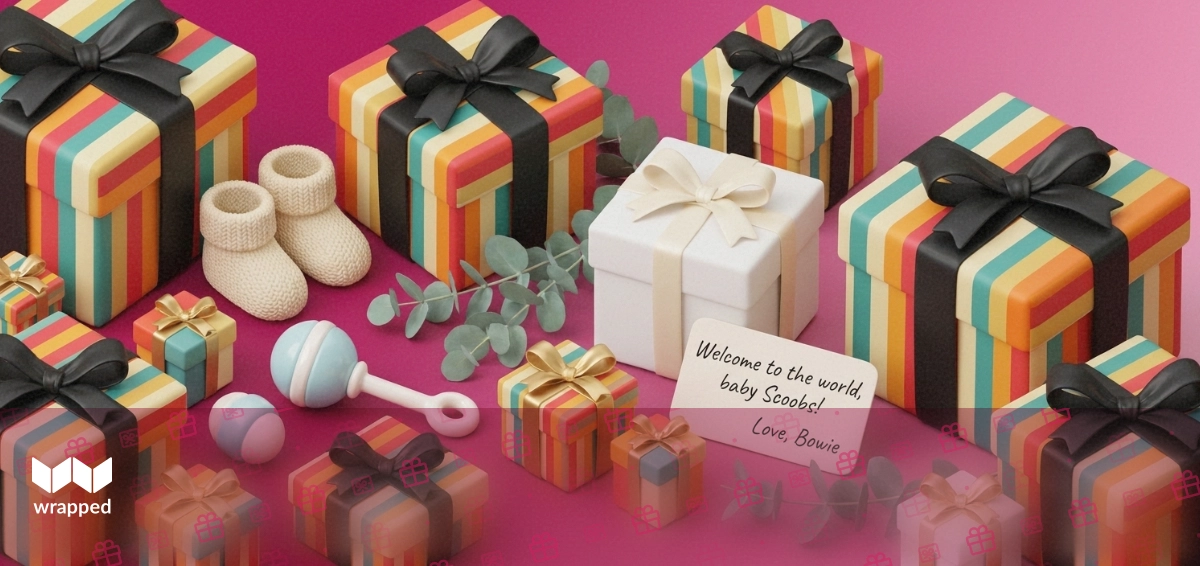
The most quietly lovely pattern of the week showed up on opposite sides of the planet. In both the United States and Australia, one in seven gifts was for a new baby. Friends in Australia celebrated couples welcoming their first child; grandparents in the United States welcomed new arrivals into the family.
The products tell the same story twice. Pearl bracelets, small boxes, knitted things and soft ribbon, all moving toward households that are suddenly very short on sleep. New baby gifts made up a tenth of all gifting worldwide this week, steady rather than spiking, which is what a reliable occasion looks like.
For merchants, the useful part is that this occasion barely follows a calendar. There is no date to prepare for, which means the gifting option has to be permanently available rather than seasonally switched on.
The map stretched past the usual markets
Just under half of all gifting came from the United States this week, with Britain next, and then a cluster of markets that each took a small but real slice. Gifting from the United Arab Emirates made up 4% of everything, level with Canada and Australia, and it arrived in Arabic as well as English.
That cluster is where the texture lives. Jewelry counters, chocolate shops and florists carried much of the Gulf's gifting, while Dutch, Spanish, French and Turkish turned up elsewhere in the week. Altogether, 59% of gifting came from outside the United States, which is a useful thing to remember before writing gift copy that only works in one language.
Australia, meanwhile, kept its own shape: six in ten gifts there were birthday gifts, with new baby gifts taking the next largest place and friends doing a lot of the sending. Britain leaned on cake, Australia leaned on cake and cribs, Canada leaned on everything.
What this means for merchants
Regional differences like these are a reason to keep gifting options broad rather than tuned to one occasion. A store that only surfaces gifting around seasonal peaks will catch British birthdays and miss Canadian thank-yous entirely, and it will miss new baby gifting all year long because that occasion never announces itself in advance.
The practical version is short. Put a gift option where shoppers already are, on the product page, in the cart and at checkout. Let shoppers write their own message, because across every market this week the note was the part that actually crossed the border. And make sure those options appear in the shopper's own language, since nearly three in five gifts came from somewhere other than the United States.
November is next. Diwali lands in five weeks and Singles' Day follows the week after, and shoppers in India and East Asia tend to start browsing long before the dates arrive.
This week in gifting
69% of British gifting was for a birthday 43% of all gifting worldwide was for birthdays 14% of gifts in both the United States and Australia were for new babies 59% of gifting came from outside the United States 4% of gifting came from the United Arab Emirates 23% of gifts had no occasion attached at all