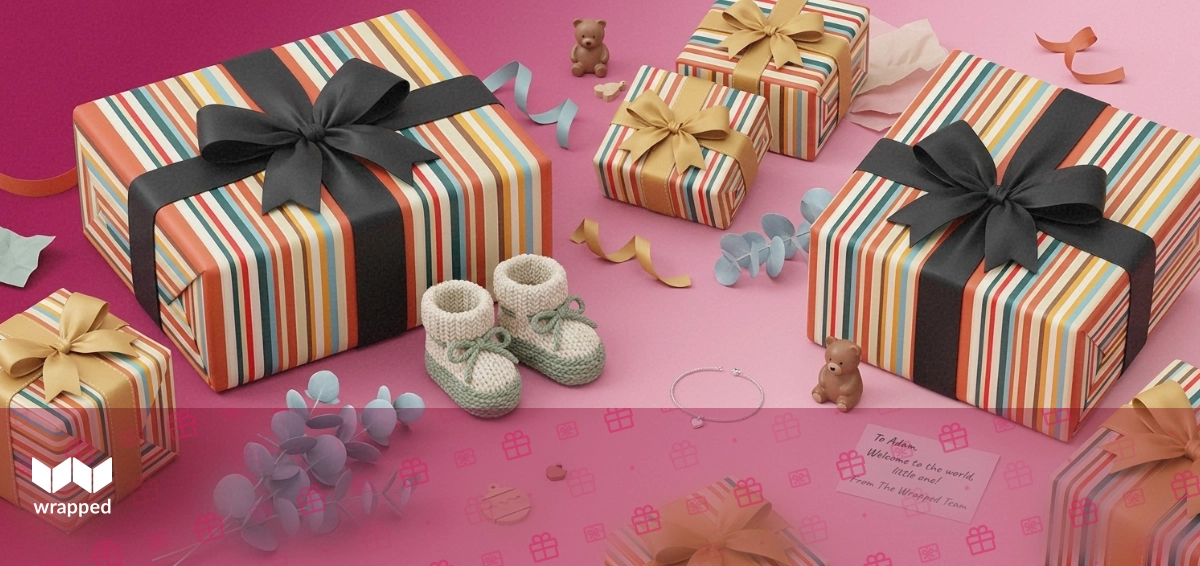
Birthdays run the world of gifting most weeks, and this week was no exception. Then there is Australia, where the second most common reason to send a gift was not a birthday, a thank you, or a just-because parcel. It was a baby.
Nearly one in five gifts sent from Australia this week welcomed a new arrival, with families celebrating boys and girls and grandparents joining in from other time zones. Notes of comfort also showed up more often in Australian gifting than anywhere else in the mix, which makes for an unusual pairing: a country sending both its happiest news and its gentlest.
Birthdays led almost everywhere. In Australia, new babies came next.
The map got wider than English
More than half of this week's gifting started somewhere other than the United States. That shows up in language before it shows up anywhere else. Gift notes travelled in Spanish, Turkish, French, German, Arabic, Italian, Dutch and Swedish, with English still doing most of the talking but clearly sharing the room.
The regional contrasts are sharper than the totals suggest. In Britain, two of every three gifts were for a birthday, with almost nothing else getting a look in. American gifting was more evenly spread, with birthdays under half the total and a large stack of gifts carrying no occasion at all. Canada and India both sat in the mix at a smaller scale, mostly with jewelry and boxed gifts.
For merchants, the useful part is that these are not the same customer with a different address. A British shopper is most likely buying for a birthday. An Australian shopper might be buying for a nursery. The gifting options that feel obvious in one market can feel beside the point in another.
India is warming up before Raksha Bandhan
Raksha Bandhan arrives in three weeks, and gifting from India is already pointing that direction, with early rakhi gifts appearing alongside birthday parcels. Sibling gifting is the piece that August tends to grow, and it behaves differently from most occasions: one shopper often sends several gifts at once, each meant for a different person.
Family gifting carried two of every five gifts worldwide this week, the largest relationship group by a comfortable margin. Parents, siblings and grandparents were behind the necklaces, bracelets and boxed gifts moving between countries. Friends took the next slice, mostly with birthday shirts and books.
The product mix tells the same story from another angle. Necklaces were the single most gifted item, followed by cards, wrapping and bracelets. Small, personal, and easy to post: exactly what you would expect from a week where gifts crossed borders more often than they stayed home.
What this means for merchants
If a meaningful part of gifting is arriving from outside a store's home market, the gifting experience has to read naturally in more than one language and more than one occasion. Translated gift options and gift messaging cost nothing to offer and change how a shopper feels at the moment they decide to send something to someone far away.
It also pays to look at which occasions a store is quietly serving. Baby gifts, sibling gifts and no-occasion parcels all behave differently from birthdays, and each one rewards a slightly different setup: per-item gift options for shoppers sending several gifts in one order, a gift option in the cart for the shopper who realises halfway through that this is a present. The gifting is already happening. The only question is whether the store makes it easy.
This week in gifting
57% of gifting started outside the United States 18% of gifts sent from Australia were for new babies 66% of British gifting was for birthdays 39% of gifts travelled between family members 13% of gifted items were necklaces


